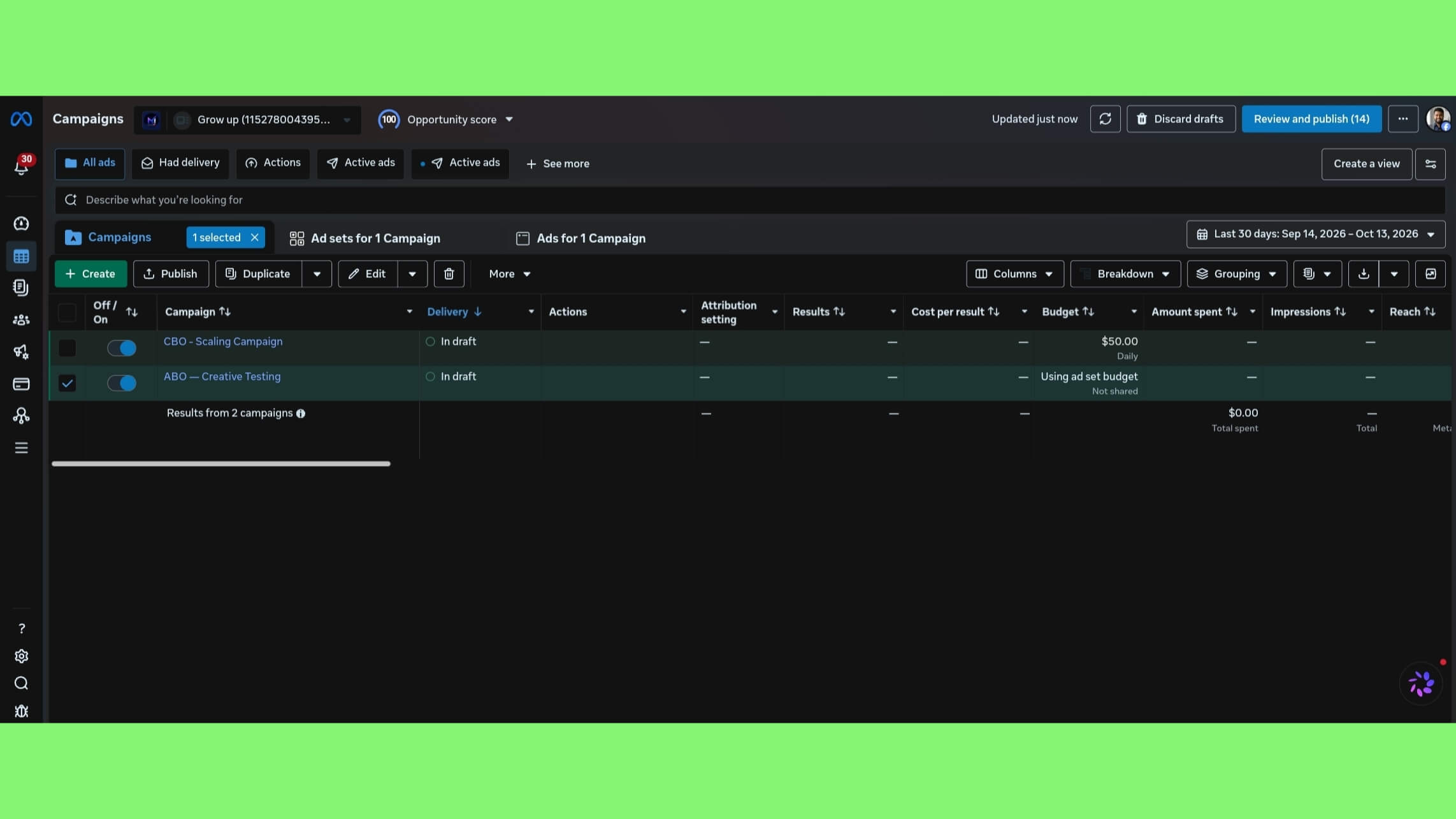
Random campaign structures waste budget. A clear testing → scaling pipeline keeps learning and spend under control.
Here is the ABO to CBO framework I use for most accounts — simple, repeatable, and grounded in real creative testing.
Why Structure Matters
Two people can run the same ad creative with the same audience and get completely different results. The difference is usually structure.
Without structure, you cannot tell what is working. Was it the creative? The audience? The placement? Without isolating variables, you are guessing.
The ABO to CBO pipeline solves this by separating learning from scaling.
What ABO and CBO Mean
ABO = Ad Set Budget Optimization. You set the budget at the ad set level, so each ad set gets its own spend. Meta does not redistribute budget between ad sets.
CBO = Campaign Budget Optimization (now called Advantage Campaign Budget). You set the budget at the campaign level, and Meta decides how to allocate it between ad sets.
Each has a purpose:
- ABO — best for testing, because each variable gets equal spend
- CBO — best for scaling, because Meta allocates budget to the best performers
Phase 1: Test (ABO)
The first phase is about learning. You want clean data on which creatives actually work.
Setup
- One ABO campaign
- 3-5 ad sets, each with a different creative angle
- Same audience, same placement, same budget per ad set
- Equal spend so the comparison is fair
What to Test
Test creative angles, not audience variations. In most accounts, the creative matters more than the audience.
Examples of angles:
- Problem-solution ("Struggling with X? Try Y")
- Social proof ("10,000+ customers")
- Founder story ("I built this because...")
- Before/after
- Objection handling ("Worried about Z? Here is how we solve it")
Kill Rules
Before you launch, define the rules for killing a losing ad set:
- After spending 2-3× your target CPA with zero conversions, pause it
- After spending 2× target CPA with a CPA above 2× target, pause it
- If CTR is below 0.5% after $20+ spend, the hook is not working
Phase 2: Scale (CBO)
Once you have 1-2 clear winners from ABO testing, it is time to scale them.
Setup
- One CBO campaign
- Move the winning creatives into it
- One broad audience (let Meta's algorithm work)
- Set your target ROAS or CPA
How to Raise Budget
Do not jump the budget 5× overnight. Meta needs time to adapt, and sudden jumps reset the learning phase.
Instead:
- Increase budget by 20-30% every 2-3 days
- Watch CPA and frequency carefully after each increase
- If CPA rises more than 20% after an increase, pause and stabilize
- Never more than one increase per 48 hours
Watch These Metrics
While scaling, monitor:
- ROAS or MER — the primary metric
- CPA — should stay near target
- Frequency — if above 3.0, creative fatigue is setting in
- CTR — a drop signals the hook is losing effect
- CPM — rising CPM means you are hitting auction limits
Creative > Audience
Most beginners obsess over audience targeting. They spend hours building lookalike audiences, exclusion lists, and interest stacks.
In practice, creative angle and hook matter more.
Meta's algorithm has gotten very good at finding buyers within a broad audience. What it cannot do is invent a better creative for you.
So focus on:
- Testing new hooks every week
- Iterating on winning creatives (new angles, new visuals)
- Refreshing ad fatigue before frequency hits 3.0
Once you have signal, keep audiences broad and let Meta do its job.
Budget Allocation Rules
How much should go to testing vs. scaling?
A simple split:
- 70% to proven winners (CBO)
- 20% to new creative tests (ABO)
- 10% to experimental angles or new audiences
This keeps the machine running while continuously feeding new creative into the pipeline.
When the Framework Needs Adjustment
The ABO → CBO pipeline is not universal. It works well for:
- E-commerce with clear purchase events
- Lead generation with form fills
- Accounts with $30+ daily spend
It may need adjustment for:
- Very small budgets (under $10/day)
- Long sales cycles with offline conversions
- Brands with unusual audience structures
But even in those cases, the principle is the same: test in isolation, scale in aggregation.
The Real Lesson
Meta Ads structure is not about finding a magic campaign type. It is about isolating variables so you can learn, then scaling what works.
Test in ABO. Scale in CBO. Refresh creatives constantly. Keep the audience broad.
That is the whole game — and everything else is optimization.