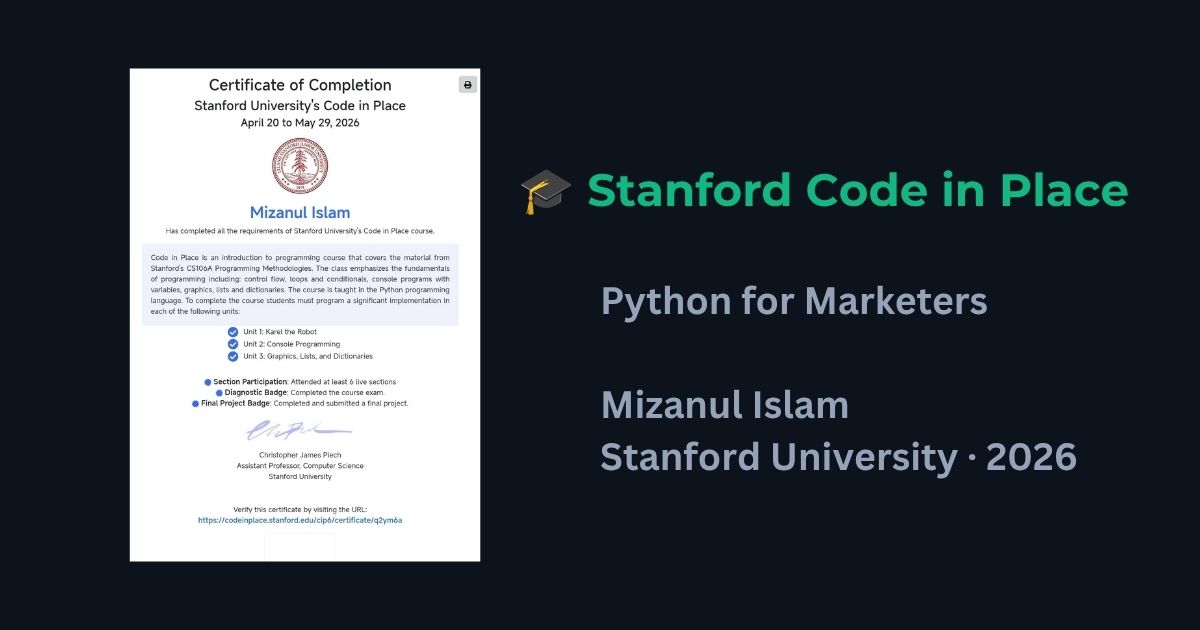
I recently completed Stanford University's Code in Place program — a free, live-taught introduction to Python. It is designed for beginners, and it changed how I think about marketing technology.
Here is what I learned, why it matters for marketers, and whether you should consider doing it too.
What is Code in Place?
Code in Place is a free, six-week Python course offered by Stanford University. It runs once a year and has thousands of students from around the world.
The structure is unique:
- Weekly lectures from Stanford professors
- Small group sections with volunteer section leaders
- Weekly problem sets to practice the concepts
- Final project where you build something real
The whole thing is live and interactive — not just a video course. That is what makes it different.
Why Marketers Should Learn Python
You might think code is for developers, not marketers. But modern marketing runs on APIs, webhooks, and server-side tracking. Understanding code makes you dramatically more effective.
Here is what you can do once you understand Python:
- Read and modify tracking scripts — not just copy-paste from a tutorial
- Understand CAPI payloads and event parameters
- Debug server-side GTM issues faster than waiting for a developer
- Automate reporting tasks — pull GA4 data, format it, email it weekly
- Talk to developers in their language instead of describing what you want
What Code in Place Taught Me
The Basics — Variables, Loops, Functions
The first few weeks cover Python fundamentals. Variables, conditionals, loops, functions. Nothing advanced, but solid.
Breaking Problems into Small Steps
The most valuable lesson was not any specific syntax. It was the mindset: break a big problem into small, testable steps.
This applies directly to marketing. When a campaign underperforms, you do not try to fix everything at once. You isolate the variable — creative, audience, offer, landing page — and test one thing at a time.
Reading Documentation Without Fear
Before Code in Place, opening Python documentation felt intimidating. Now it feels like reading a manual — you look up what you need, understand it, and move on.
Debugging Patience
When your code does not work, the first instinct is frustration. The program taught me to slow down, read the error message, and test one thing at a time.
What I Built in the Final Project
The final project was my first real Python script. I built a small tool that:
- Reads a CSV file of campaign data
- Calculates ROAS per campaign
- Flags campaigns below a threshold
- Outputs a simple summary
It was rough. But it worked — and it was mine.
Since then, I have used Python for other small tasks — automated data cleanup, formatting reports, and a few utility scripts for the marketing tools on this site.
Should You Do Code in Place?
If you are a marketer who wants to stand out, yes. The program is free and runs once a year.
But even if you do not get into Code in Place, there are other options:
- CS50 — Harvard's free intro to computer science
- freeCodeCamp — free, self-paced Python track
- Automate the Boring Stuff with Python — book focused on practical automation
- Python for Everybody — University of Michigan course on Coursera
The specific program matters less than actually starting. Pick one and commit to it.
How Long Does It Take?
Code in Place runs for 6 weeks, with about 5-6 hours of commitment per week. That is less than most online courses, and the structure keeps you accountable.
If you do a self-paced alternative, expect 4-8 weeks to get comfortable with the basics.
What This Means for My Marketing
Understanding Python has changed how I approach tracking and automation:
- I read CAPI documentation instead of just following tutorials
- I can debug tracking issues without waiting for a developer
- I write small scripts to automate repetitive tasks
- I understand what server-side code is actually doing
None of this made me a developer. It made me a better marketer.
The Real Lesson
Code in Place is not about becoming a programmer. It is about understanding the systems that power modern marketing.
If you are serious about performance marketing, growth tracking, or building systems that scale — learning to code is one of the highest-leverage investments you can make.
Start with Python. Pick any course. Commit to 5 hours a week for 6 weeks. You will come out the other side a different marketer.